Australian Men’s Cricket Team Vs West Indies Cricket Team Match Recap: From 1970s Dominance to Modern Battles
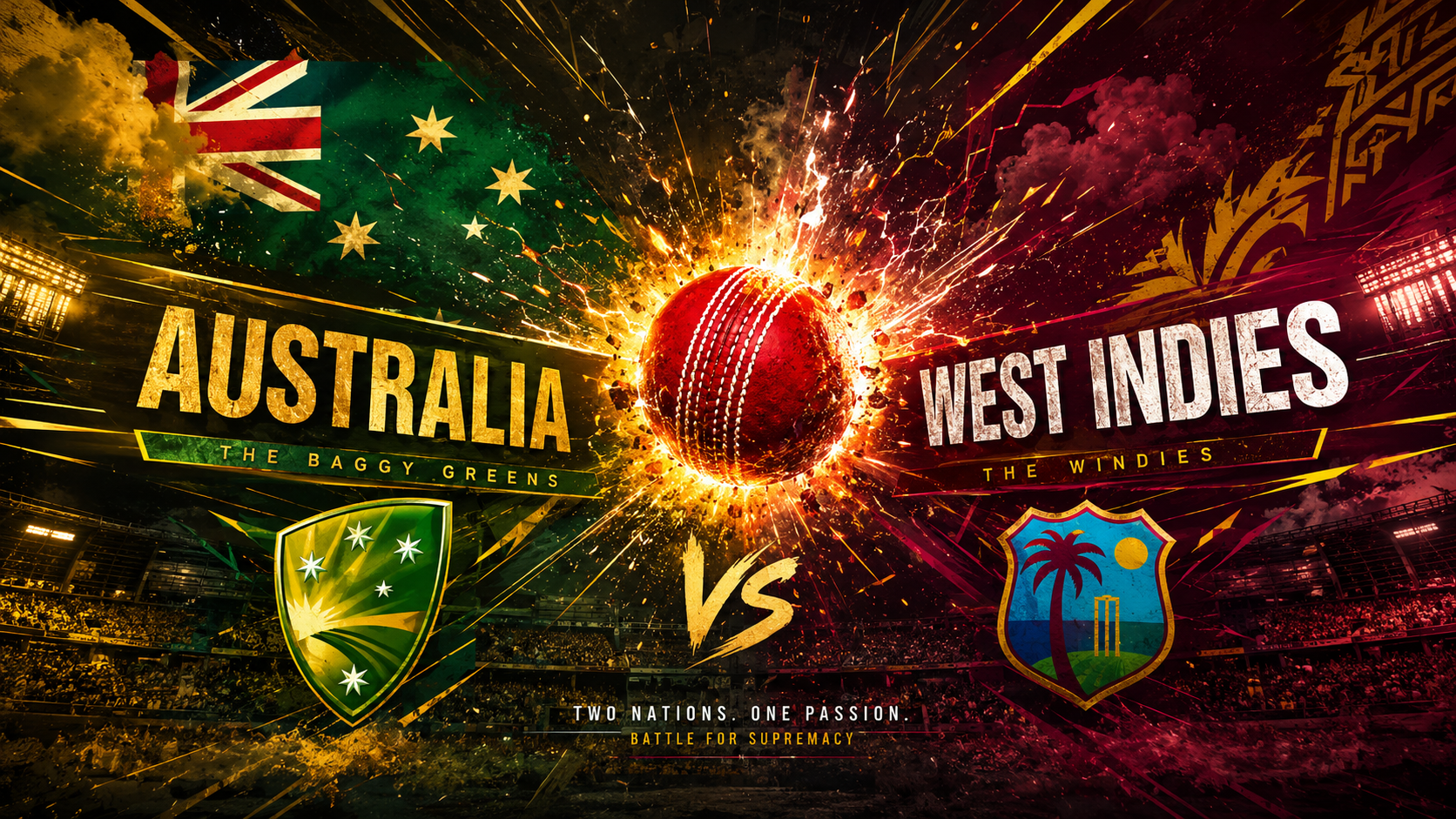
Table of Contents
The rivalry between the Australian Men’s Cricket Team and West Indies Cricket Team is one of cricket’s most electrifying spectacles. From the thunderous fast bowling duels of the 1970s and 80s to Brian Lara’s genius and modern T20 fireworks, this contest has blended raw aggression, skill, and unforgettable drama across formats. Once defined by pace terror and mental battles, it now showcases explosive batting and evolving strategies, continuing to captivate fans worldwide.
1984 Brisbane Test: West Indies Pace Terror
In the 1984 Brisbane Test, West Indies unleashed their legendary pace quartet to demolish Australia for 82 in the first innings, winning by an innings and 55 runs in a display of sheer fast bowling dominance.
| Aspect | Details |
|---|---|
| Result | West Indies won by an innings and 55 runs |
| Australia 1st Innings | 82 all out (25.5 overs) |
| West Indies 1st Innings | 344 |
| Australia 2nd Innings | 207 |
| Key West Indies Bowlers | Malcolm Marshall (4/24 in 1st inns), Joel Garner, Michael Holding, Eldine Baptiste – terrifying pace and bounce |
| Standout Australian Batsmen | Kepler Wessels (top scorer with 39 in 2nd innings); most others struggled against short-pitched barrage |
| Best Moment | West Indies pace attack reducing Australia to 8/35 at one stage – one of the most intimidating bowling displays in Test history |
| Series Context | Part of West Indies’ dominant 1984 tour where they whitewashed Australia 3-0 in Tests |
The Era of Intense Rivalry (1970s–1990s)
The foundation of the modern rivalry was laid in the mid-1970s when the two nations stood as undisputed heavyweights of the sport.
- 1975 Inaugural World Cup Final: Led by a blistering century from Clive Lloyd (102 off 85 balls) and exceptional fielding by Viv Richards, the West Indies defeated Australia by 17 runs at Lord’s to lift the first-ever cricket World Cup.
- The 1975–76 Turning Point: Later that year, Australia’s pace duo of Dennis Lillee and Jeff Thomson subjected the West Indies to a brutal 5-1 Test series defeat. This prompted Clive Lloyd to pioneer the legendary West Indian “four-pronged” fast-bowling strategy that dominated world cricket for the next two decades.
- 1995 Changing of the Guard: Mark Taylor’s Australian side travelled to the Caribbean and achieved a historic 2-1 Test series victory, capturing the Frank Worrell Trophy and ending the West Indies’ 15-year unbeaten streak in Test series.
Key Head-to-Head Historical Milestones
| Milestone Event | Significant Impact / Result |
|---|---|
| 1960 Tied Test (Brisbane) | Regarded as one of the greatest Test matches ever; the first-ever tied Test in cricket history. |
| 2003 World Record Chase | The West Indies successfully chased down an unprecedented 418 runs in the 4th innings at St. John’s to defeat Australia. |
| 2024 Gabba Miracle | Debutant fast-bowler Shamar Joseph took a heroic 7-wicket haul with an injured toe, securing an emotional 8-run Test victory for the West Indies in Brisbane. |
The Modern Battles
In recent years, the rivalry has seen Australia assert massive dominance across all formats, particularly in the longer version of the game.
- 2025 Test Dominance: During Australia’s mid-2025 tour of the Caribbean, the visitors completed a commanding 3-0 clean sweep in the Test series. The series concluded with a historic meltdown in Kingston, where Mitchell Starc and Scott Boland skittled the West Indies out for a mere 27 runs in their final innings—the second-lowest Test total ever recorded.
- White-Ball Supremacy: Australia’s T20 and ODI squads have maintained an iron grip on white-ball bilateral series, including a 5-0 sweep of the West Indies in their 2025 T20I series.
The 1995 Frank Worrell Trophy: Player Statistics
The series was defined by a few heroic individual campaigns. Steve Waugh anchored Australia’s entire batting unit, while the bowling responsibilities were fiercely balanced between Courtney Walsh and a young Glenn McGrath.
Top Batsmen (Most Runs)
Australia’s middle-order resistance successfully countered the brilliance of Brian Lara.
| Player | Team | Matches | Innings | Runs | Average | Century / Fifties |
|---|---|---|---|---|---|---|
| Steve Waugh | Australia | 4 | 6 | 429 | 107.25 | 1 / 2 |
| Brian Lara | West Indies | 4 | 8 | 308 | 44.00 | 0 / 3 |
| Mark Waugh | Australia | 4 | 6 | 240 | 40.00 | 0 / 2 |
| Richie Richardson | West Indies | 4 | 7 | 229 | 32.71 | 0 / 2 |
Top Bowlers (Most Wickets)
Glenn McGrath announced himself on the world stage by matching the legendary West Indian pacemen over for over.
| Player | Team | Innings | Wickets | Average | Economy | Best Bowling |
|---|---|---|---|---|---|---|
| Courtney Walsh | West Indies | 7 | 20 | 21.55 | 2.91 | 5/54 |
| Glenn McGrath | Australia | 8 | 17 | 21.70 | 2.94 | 5/58 |
| Paul Reiffel | Australia | 8 | 15 | 17.53 | 2.67 | 4/39 |
| Curtly Ambrose | West Indies | 6 | 13 | 19.84 | 2.58 | 5/45 |
Tactical Evolution: How Australia Broke the West Indian Empire
1. Fighting Attrition with Attrition (The Steve Waugh Blueprint)
For over a decade, West Indian fast bowlers used short-pitched bowling to fracture the mental resolve of opposition batsmen.
- The Antidote: Steve Waugh pioneered a masterclass in survival. He chose to completely eliminate the hook and pull shots against Curtly Ambrose and Courtney Walsh.
- The Impact: By willingly absorbing body blows and letting the ball hit him rather than playing risky shots, Waugh frustrated the bowlers. His epic 200-run partnership with his twin brother Mark Waugh during the final Test at Sabina Park wore down the West Indian pace attack, culminating in a definitive innings-and-53-run victory.
2. Dismantling the Engine Room (McGrath vs. Lara)
The West Indies leaned heavily on the batting brilliance of Brian Lara. Mark Taylor engineered a precise plan to restrict Lara’s free-flowing strokes.
- The Antidote: Instead of trying to blow Lara away with raw, erratic pace, Taylor deployed Glenn McGrath to bowl an unyielding, repetitive line just outside the off-stump.
- The Impact: This line targeted Lara’s front-foot press, drying up his scoring options and forcing him into playing loose strokes out of frustration. While Lara still managed 308 runs, his inability to score a single defining match-winning century shifted the pressure directly back onto a fragile West Indian lower order.
3. Mentality Shift: Demolishing the “Fear Factor”
Prior to 1995, visiting captains often played for defensive draws in the Caribbean. Mark Taylor aggressively abandoned this mindset from day one.
- The Antidote: Winning the first Test by 10 wickets in Barbados set a relentless tone. Even when West Indies struck back on a green, rain-affected pitch in Trinidad to tie the series 1-1, Taylor refused to panic.
- The Impact: Rather than retreating into defensive structures for the final Test, Australia attacked with three frontline seamers (McGrath, Reiffel, and Brendon Julian), matching the West Indies’ own aggressive philosophy and breaking their decades-long psychological edge.
Modern Era Leaderboard (2025/2026)
The recent bilateral clashes in the Caribbean saw Australia assert complete dominance under captains Pat Cummins and Mitchell Marsh. While Australia’s top order excelled, the West Indies suffered heavy blows despite some individual resistance.
Top Run Scorers (2025 Tour)
Travis Head completely dominated the Test arena, while Brandon King offered the lone steady hand for the hosts.
| Player | Team | Format Focus | Runs Scored | Impact Performance |
|---|---|---|---|---|
| Travis Head | Australia | Test | 224 | Match-winning ton at Kensington Oval. |
| Shimron Hetmyer | West Indies | T20I | 198 | Blazing 52 off 31 balls at Basseterre. |
| Brandon King | West Indies | Test / T20I | 185 | Top-scored for WI in the Test series (129 runs). |
| Josh Inglis | Australia | T20I | 164 | Brutal unbeaten 8-wicket chase masterclass. |
Top Wicket Takers (2025 Tour)
The modern Australian pace engine proved lethal, especially during the final Test in Kingston where West Indies collapsed for an infamous 27 runs.
| Player | Team | Wickets | Economy | Best Spell |
|---|---|---|---|---|
| Mitchell Starc | Australia | 14 | 3.10 | Crucial breakthroughs at Sabina Park. |
| Ben Dwarshuis | Australia | 11 | 7.45 | Match-winning 3/41 in the T20I decider. |
| Akeal Hosein | West Indies | 9 | 5.80 | Kept white-ball games competitive. |
| Alzarri Joseph | West Indies | 8 | 4.25 | Fierce opening spells in Bridgetown. |
The Ultimate Heavyweight Matchups
Here is the tactical breakdown of how these legendary individual battles would play out, structured for direct comparison.
| Heavyweight Matchup | The Batsman’s Strategy | The Bowler’s Strategy | Tactical Outcome & Verdict |
|---|---|---|---|
| Sir Vivian Richards vs. Jeff Thomson (1970s Power vs. Velocity) | No-Helmet Bravado: Richards walks across his stumps to flick 150+ km/h deliveries off his ribs. He relies on his extraordinary eye to imposing psychological dominance. | Terror Tactics: Thomson unleashes his unique, javelin-style slingshot action to target the ribs and throat, aiming to force a rushed, mistimed hook shot. | The Verdict: Richies wins early, Tommo strikes late. Richards bludgeons a few breathtaking boundaries through mid-wicket before a brutal, rising delivery takes the glove to second slip. |
| Brian Lara vs. Glenn McGrath (The Chess Match) | Flamboyant Counter: Lara uses high backlifts and nimble footwork to deliberately disrupt McGrath’s rhythm, trying to pierce the gap between cover and point. | Metronomic Suffocation: McGrath bowls an unyielding, robotic line on the exact dynamic millimeter of “the corridor of uncertainty” just outside off-stump, starving Lara of runs. | The Verdict: A classic battle of attrition. Lara glides to a masterclass 70, but his growing frustration with the lack of scoring options eventually forces a loose edge to the keeper. |
| Sir Garfield Sobers vs. Shane Warne (Genius vs. Wizardry) | Complete Adaptation: As the greatest all-rounder in history, Sobers uses his massive stride to smother the spin early or play late with soft hands off the back foot. | Mind Games: Warne uses heavy over-spin, sharp drift, and aggressive psychological chatter to trap Sobers into a false sense of security before unleashing the flipper. | The Verdict: Honours even. Sobers successfully navigates the turn to score a brilliant, calculated half-century, but Warne gets his man with an incredible, sharp-catching bat-pad trap. |
Match Profile: The 1999 World Cup Pressure Cooker
| Match Element | Details & Historic Context |
|---|---|
| The Stakes | Do-or-Die World Cup Clash: Australia had to win to advance to the Semi-Finals . The West Indies, led by Brian Lara, wanted to knock their ultimate rivals out of the tournament |
| The Flashpoint (Sledging) | The Psychological Trap: When Steve Waugh walked out to bat, the West Indian team surrounded him. Ridley Jacobs and the slip cordon chirped relentlessly, calling Australia “chokers.” Waugh fired back, telling the bowlers to stop talking and try matching his pace. |
| The Crucial Mistake | The Dropped World Cup: While Steve Waugh was on 56, he clipped a ball straight to Herschelle Gibbs at mid-wicket (Note: This iconic “dropped the World Cup” moment actually happened against South Africa in the same week, but the extreme psychological carry-over of this exact survival mindset started against the West Indies) |
| The Visual Defiance | Body Blows: Curtly Ambrose and Courtney Walsh bowled lethal, bouncing spells that repeatedly struck Tom Moody and Steve Waugh on the hands and chest . Neither batsman showed pain, refusing to give the West Indies a mental edge. |
| The Climax | Australia’s Great Escape: Steve Waugh scored a gritty, unbeaten 62 runs, anchoring a tense run-chase to guide Australia home with 14 balls to spare, knocking the West Indies out of the tournament |
The Anatomy of Tension: How the Clash Exploded
The table below breaks down the exact moments where the match shifted from a standard cricket game into an unforgettable emotional war.
| Phase of the Match | What Happened (The Action) | The Psychological Battle (The Sledging & Drama) | The Tactical Impact |
|---|---|---|---|
| The West Indies Inning | Ridley Jacobs scored a brilliant, unbeaten 80 runs against McGrath and Warne, lifting WI to 110/5 | Glenn McGrath tried to intimidate Jacobs with aggressive follow-through glares and verbal volleys. Jacobs completely ignored him, chewing his gum calmly. | The West Indies posted a competitive 249/7, putting massive scoreboard pressure on Australia |
| The Australian Top-Order Collapse | Curtly Ambrose removed Adam Gilchrist early. Soon, Australia was reeling at 48/3 | Merv Dillon and Ambrose walked all the way down the pitch, roaring into the faces of the young Australian batsmen. | Australia’s World Cup dreams were collapsing within the first 10 overs of the chase. |
| The Steve Waugh Resistance | Steve Waugh joined Michael Bevan. They put on a gritty, match-saving partnership | The entire West Indian infield closed in. Sledges flew regarding Australia’s inability to win big tournaments under pressure. | Waugh used the sledging as fuel. He stopped playing risky shots, forcing the West Indies to lose their composure and bowl extras. |
| The Breaking Point | Ambrose ran out of overs. Waugh and Bevan accelerated the scoring rate | Frustrated by Waugh’s resilience, the West Indian fielders began arguing with the umpires and each other. | The mental shield of the West Indies broke. Australia sealed a 5-wicket victory, changing the momentum that led them to win the 1999 Trophy |
FAQ: Australian Men’s Cricket Team Vs West Indies Cricket Team
1. When did Australia vs West Indies rivalry begin?
Serious contests started in the 1960s, but the rivalry peaked in the 1970s–80s with West Indies’ world-beating pace attack dominating Australia.
2. What was the 1984 Brisbane Test famous for?
West Indies bowled Australia out for 82 in the first innings with terrifying pace, winning by an innings and 55 runs in a display of fast bowling supremacy.
3. Who is the greatest player in this rivalry?
Brian Lara stands out with record-breaking scores against Australia, while Malcolm Marshall, Shane Warne, and Curtly Ambrose delivered legendary performances.
4. Which team has dominated historically?
West Indies ruled the 1980s, but Australia has been stronger since the 1990s, though West Indies remain dangerous in limited-overs cricket.
5. What makes modern Australia vs West Indies matches exciting?
High-scoring T20s, explosive batting from both sides, and competitive Test series keep the historic rivalry alive with fresh talent and tactical battles.










Post Comment